
What Is Network Infrastructure Validation? A Complete Guide for Reliable, Secure, and High-Performance Networks
Modern businesses rely on their networks for almost everything. Emails, cloud applications, security systems, VoIP calls, surveillance cameras, and connected devices all depend on a reliable network. But installing cables and networking equipment is only part of the job. The real question is simple:
Does your network actually perform the way it was designed to?
That’s exactly where network infrastructure validation comes in.
Think of it like building a new bridge. Engineers don’t simply finish construction and hope it works. They inspect every component, test its strength, and verify that it meets safety standards before allowing traffic to cross.
A business network deserves the same level of attention.
In this guide, you’ll learn what network infrastructure validation is, why it matters, how the process works, and why organizations across Maryland choose experienced professionals like ClearPath ICT Solutions to ensure their network performs reliably from day one.

What Is Network Infrastructure Validation?
Network infrastructure validation is the process of testing, inspecting, documenting, and verifying that a network has been installed correctly and performs according to design specifications, industry standards, and business requirements.
Instead of assuming everything works, validation confirms that every part of the infrastructure functions as expected before the network goes live.
A complete validation process may include:
- Fiber optic testing
- Copper cable certification
- Equipment verification
- Switch and router connectivity checks
- Wireless performance testing
- Network performance verification
- Documentation review
- Labeling inspection
- Security validation
- Compliance testing
The goal is straightforward:
Ensure the network is reliable, secure, scalable, and ready for production.
Without proper validation, hidden issues may remain unnoticed until users begin experiencing slow connections, outages, or application failures.
What Is Network Infrastructure?
Before discussing validation, it’s important to understand what network infrastructure is.
Network infrastructure refers to all the hardware, software, cables, devices, and systems that allow computers and other connected devices to communicate.
Typical components include:
- Fiber optic cabling
- Copper Ethernet cabling
- Routers
- Network switches
- Firewalls
- Wireless access points
- Patch panels
- Network racks
- Servers
- Internet connections
- Power systems
Together, these components create the foundation of every modern business network.
Whether it’s a hospital, government office, school, warehouse, manufacturing plant, or corporate office, the network infrastructure supports daily operations.
Why Network Infrastructure Validation Matters
Many organizations assume that if devices power on, the network is ready.
Unfortunately, that assumption can become expensive.
Small installation mistakes often stay hidden until employees begin using cloud applications, transferring large files, or running business-critical systems.
Validation helps identify problems before they affect operations.
Some common issues include:
- Incorrect cable terminations
- Fiber loss exceeding acceptable limits
- Poor cable labeling
- Configuration errors
- Faulty patch panels
- Signal interference
- Performance bottlenecks
- Security weaknesses
Finding these problems before deployment reduces downtime, prevents costly troubleshooting, and improves long-term reliability.
Why Businesses in Maryland Should Validate Their Networks
Organizations throughout Maryland increasingly depend on cloud computing, hybrid work, security systems, and connected devices.
Whether you’re operating a healthcare facility in Baltimore, a government office near Annapolis, or a growing business anywhere in Maryland, network reliability directly affects productivity.
Proper network infrastructure services help organizations:
- Reduce unexpected downtime
- Improve user experience
- Protect business data
- Meet project requirements
- Support future expansion
- Reduce maintenance costs
Validation becomes even more important for businesses planning upgrades, office relocations, or new construction projects.

How Network Infrastructure Validation Works
Although every project differs, most validation projects follow a structured process.
1. Review the Network Design
The process begins by reviewing project documentation.
Engineers compare the installed infrastructure against:
- Network diagrams
- Construction drawings
- Customer requirements
- Industry standards
- Manufacturer recommendations
This creates a clear baseline before testing begins.
2. Inspect the Physical Installation
Visual inspections help identify obvious installation issues before performance testing.
Technicians inspect:
- Cable routing
- Bend radius
- Rack organization
- Patch panels
- Cable management
- Labels
- Grounding
- Equipment placement
A neat network isn’t just satisfying to look at it also simplifies maintenance and future upgrades.
3. Test Cabling Performance
Cabling forms the backbone of every computer network infrastructure.
Professional testing verifies that cables meet performance specifications.
Common tests include:
Technicians measure:
- Optical loss
- Link length
- Continuity
- Connector quality
- Signal integrity
Industry-standard tools such as Optical Loss Test Sets (OLTS) and Optical Time Domain Reflectometers (OTDR) help identify installation issues.
Copper Cable Certification
Copper certification verifies:
- Wire mapping
- NEXT (Near-End Crosstalk)
- Return loss
- Insertion loss
- Signal quality
- Cable length
These tests help ensure cables support the intended network speeds.
4. Verify Network Equipment
Validation also includes active equipment.
Technicians verify:
- Switch operation
- Router functionality
- Firewall connectivity
- VLAN configuration
- Port status
- Power over Ethernet (PoE)
- Redundancy
Every device should communicate correctly before users rely on it.
5. Evaluate Network Performance
Once equipment is operational, engineers evaluate network performance.
Typical checks include:
- Latency
- Packet loss
- Throughput
- Bandwidth utilization
- Link stability
- Failover performance
Performance testing confirms the network supports expected workloads.
6. Review Network Infrastructure Security
Strong network infrastructure security protects business operations.
Validation often includes reviewing:
- Firewall rules
- Network segmentation
- Access control
- Password policies
- Device firmware
- Secure management access
The goal isn’t to perform a full cybersecurity audit but to verify that essential security configurations align with project requirements.
7. Prepare Documentation
Good documentation saves countless hours in future maintenance.
Final reports often include:
- Test results
- Certification reports
- Cable identifiers
- Equipment inventory
- Updated network diagrams
- Validation findings
- Recommended corrections
Well-organized documentation also supports future troubleshooting and expansions.
Common Problems Found During Validation
Even experienced installers occasionally encounter issues.
Some of the most common include:
- Damaged fiber connectors
- Incorrect cable labeling
- Loose patch cables
- High optical loss
- Improper switch configuration
- Faulty ports
- Power problems
- Missing documentation
Finding these issues before users notice them saves significant time and money.
Enterprise Network Infrastructure Requires More Than Basic Testing
A home Wi-Fi router serves a handful of devices.
An enterprise network infrastructure may support thousands.
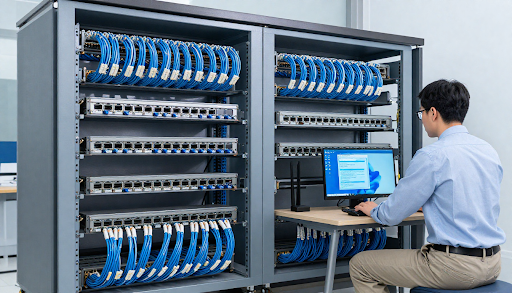
Large organizations often depend on:
- Multiple buildings
- Fiber backbones
- Data centers
- Cloud connectivity
- Wireless networks
- Security systems
- Voice communications
- Video surveillance
Validation ensures every connected system works together without creating unexpected bottlenecks.
Network Infrastructure Management Services After Validation
Validation doesn’t end when the installation finishes.
Many organizations continue with network infrastructure management services to keep systems operating efficiently.
These services may include:
- Performance monitoring
- Configuration management
- Firmware updates
- Capacity planning
- Network documentation updates
- Troubleshooting
- Preventive maintenance
Ongoing management helps organizations detect issues before they affect business operations.
Managed Network Infrastructure: A Smart Choice for Growing Businesses
Not every organization has an in-house networking team.
That’s why many businesses choose a managed network infrastructure approach.
Managed providers help with:
- Network monitoring
- Performance optimization
- Incident response
- Configuration management
- Preventive maintenance
- Reporting
- Technical support
This allows internal teams to focus on business operations instead of network troubleshooting.
Network Infrastructure Solutions That Support Business Growth
Every organization has different requirements.
Reliable network infrastructure solutions often include:
- Structured cabling
- Fiber optic deployment
- Wireless infrastructure
- Network validation
- Security improvements
- Equipment installation
- Documentation
- Network modernization
The right solution depends on business goals, growth plans, and operational needs.
Industries That Benefit from Network Infrastructure Validation
Almost every industry depends on reliable connectivity.
Validation is especially valuable for:
- Healthcare facilities
- Government agencies
- Educational institutions
- Manufacturing plants
- Warehouses
- Data centers
- Retail businesses
- Corporate offices
- Financial organizations
Any organization relying on continuous connectivity benefits from proper testing and verification.
Choosing the Right Network Infrastructure Services in Maryland
Not every service provider follows the same standards.
When selecting network infrastructure services in Maryland, consider whether the provider:
- Uses industry-standard testing equipment
- Provides detailed documentation
- Has experience with enterprise environments
- Understands fiber and copper certification
- Offers post-installation support
- Follows recognized industry best practices
Experienced professionals help reduce risk and deliver more reliable results.
Why Businesses Choose ClearPath ICT Solutions
Businesses invest heavily in network infrastructure, so they need confidence that everything works correctly before operations begin.
ClearPath ICT Solutions provides professional network validation and related infrastructure services designed to help organizations verify performance, identify installation issues, and document completed projects.
Whether supporting new construction, office expansions, or technology upgrades in Maryland, the focus remains the same:
- Accurate testing
- Thorough documentation
- Reliable verification
- Industry-standard practices
- Long-term network performance
A validated network creates a stronger foundation for business growth and future technology investments.
Frequently Asked Questions (FAQ’s)
What is network infrastructure validation?
Network infrastructure validation is the process of testing and verifying that network components have been installed correctly and perform according to design requirements and industry standards.
Why is network validation important?
Validation identifies installation errors, performance issues, and configuration problems before they affect business operations, reducing downtime and improving reliability.
How often should network infrastructure be validated?
Validation is typically performed after new installations, major upgrades, relocations, or significant infrastructure changes. Periodic assessments also help maintain long-term performance.
Is validation different from network monitoring?
Yes. Validation verifies that the network is correctly installed and functioning before or after deployment, while monitoring continuously tracks network performance during daily operations.
Who should perform network infrastructure validation?
Qualified networking professionals with appropriate testing equipment and experience should perform validation to ensure accurate results and reliable documentation.
Final Thoughts
Today’s businesses depend on reliable connectivity more than ever. A single network issue can interrupt communication, delay operations, and impact customer service.
That’s why network infrastructure validation is more than a final project checklist; it’s an essential quality assurance process.
By testing cabling, verifying equipment, reviewing configurations, checking network infrastructure security, and documenting every component, organizations gain confidence that their investment will support both current operations and future growth.
For businesses throughout Maryland, working with experienced providers such as ClearPath ICT Solutions helps ensure network infrastructure is tested, validated, and ready to perform when it matters most.